Technical due diligence: how to prepare your codebase and security for investors and acquirers
Technical due diligence helps investors and acquirers understand the technology they are backing or buying. Prepare a clear account of your architecture, engineering practices, risks and evidence, rather than a last-minute collection of screenshots.
- Who asks
- Investors and acquirers.
- What they review
- Architecture, code quality, security, access control, dependencies, AI usage and documentation.
- Scope
- Depends on the transaction and the reviewer. Agree what they need early.
- How to prepare
- Assign owners, make known gaps visible and bring evidence from your checks together.
- Keldyn's role
- Brings requirements, reviews and evidence together so your team can explain the work.
On this page
What technical due diligence reviewers look at
- Architecture: system boundaries, dependencies, deployment choices and significant design decisions.
- Code quality: maintainability, tests, review practices and known technical debt.
- Security practices: OWASP-type issues, vulnerability handling and incident processes.
- Access control: who can reach source code, production systems and sensitive data.
- Dependencies: ownership, licences, updates and third-party risk.
- AI usage and governance: where AI is used, what it can access and how AI-written changes are reviewed.
- Documentation: architecture, operational procedures, ownership and decisions.
The review scope depends on the transaction and reviewer. Agree what they need and make known gaps visible.
The reviewer's checklist
- Architecture
System boundaries, dependencies and significant design decisions.
- Code quality
Maintainability, tests, review practices and known technical debt.
- Security practices
OWASP-type issues, vulnerability handling and incident processes.
- Access control
Who can reach source code, production systems and sensitive data.
- Dependencies
Ownership, licences, updates and third-party risk.
- AI usage and governance
Where AI is used and how AI-written changes are reviewed.
- Documentation
Architecture, operational procedures, ownership and decisions.
How to prepare your codebase and security
Assign owners for architecture, security and engineering questions. Update the system map and document material risks, dependencies and decisions. Check that access permissions match current responsibilities.
Review open security findings and technical debt. Record what you fixed, what remains and why. Organise supporting material so a reviewer can follow a decision from requirement to check to evidence.
Evidence from your checks helps reviewers
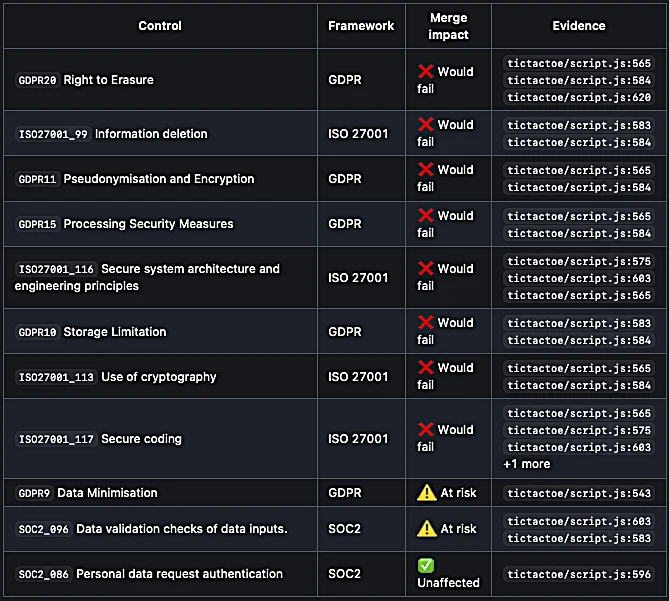
Design checks, pull request reviews and recorded remediation help explain how your team handles security requirements. Show the scope and limitations of each check, not just a pass badge.
Evidence from your tools and your checks can support technical due diligence. It does not replace the reviewer’s assessment or guarantee a transaction outcome.
How Keldyn helps
Check the design
Your coding agent maps your architecture. Keldyn builds a threat model and checks it against your frameworks before the build.
Security by design and threat modelling →Review changes
Check AI-written code against your security and compliance requirements before it merges.
AI code review and secure coding →Prepare your evidence
Evidence from your tools and your checks, ready for your auditor. Review the scope, risks and evidence with your team.
Evidence and audit →Keldyn helps you bring requirements, reviews and evidence together, so your team can explain the work and the risks clearly.
Frequently asked questions
What is technical due diligence?
It is a review of a company’s technology, engineering practices and risks for an investment or acquisition. The scope is agreed with the investor, acquirer or their reviewer.
How should we prepare for technical due diligence?
Keep architecture, ownership, access and dependencies documented. Review known risks and findings, record decisions and organise evidence from your checks so reviewers can trace the work.
Will reviewers look at AI-written code?
AI usage can form part of the review. Be ready to explain where agents are used, what they can access, how code is reviewed and how security and governance requirements are applied.
Does a security check replace technical due diligence?
No. Checks provide evidence within their scope. A reviewer still assesses architecture, engineering practices and business-specific technical risks.
“You should be building to compliance rather than fixing to it.”
 Tim Brown
Co-Founder, Kyance